Swimming Life
A Second Sport for Young Swimmers
How a counted step sport such as competitive ballroom dance can support a young swimmer through posture work, counted movement and graded competition classes.
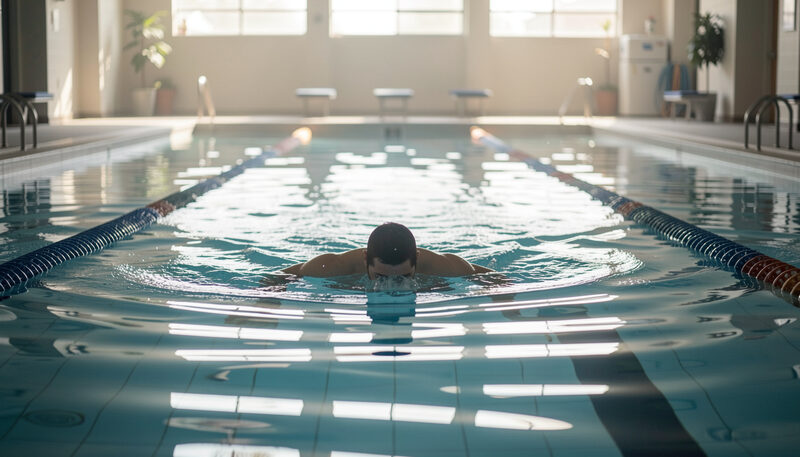
A counted step sport gives a young swimmer a second way to train posture, rhythm and body control, using movement that is measured in beats rather than lengths. It suits swimmers who already enjoy repetition and feedback, because the work is broken into countable units and graded competition classes, much as swimming is broken into age groups and qualifying times. The main gains are postural awareness, foot and ankle strength, and the habit of performing a set routine under observation.
What does a counted step sport add to a young swimmer?
Swimming develops the upper body, the lungs and a strong sense of pacing, but it leaves some gaps. A swimmer spends most of the session horizontal, with the feet unloaded and the shoulders doing much of the work. A counted step sport, by contrast, is done standing, often on a hard floor, with the weight moving from foot to foot and the spine held upright. That upright load is the first thing it adds.
The second addition is counted movement. In a counted step sport the music sets a tempo, usually given in bars per minute, and the dancer has to place a fixed number of steps inside that tempo. The swimmer already understands this idea from the pool: a 100 m split, a stroke rate, a turn count. The transfer is direct. A young swimmer who can hold a stroke count over 50 m can usually learn to hold a step count over eight bars, because both tasks ask the same thing, which is to keep a number steady while the body tires.
The third addition is posture under observation. A swimmer is watched by a coach on the poolside, but rarely by a panel. In a graded competition the dancer performs in front of judges, in a set order, with a partner or alone. That experience of being marked on form rather than on time is useful for any young athlete, and it is one reason some swimming families look at a second activity such as the Bulgarian club pages at competitive dance classes, where the programme, the age groups and the permitted figures are set out in plain terms.
How do graded competition classes compare with swimming?
Swimming and counted step sports both use a ladder, but the rungs are cut differently. Swimming age groups are usually calculated by the calendar year, and a swimmer moves up on a fixed date. Competition is then sorted by time: heats, finals, personal bests, qualifying standards. The result is a continuous scale, and a swimmer can measure progress to the tenth of a second.
A counted step sport uses classes instead of times. Beginners start in the lowest class, often labelled E, and move up through D, C, B, A and S as they learn more figures and dance more accurately. Each class has a list of dances and figures that are allowed at that level, so a competitor cannot simply perform a harder routine to gain an advantage. Promotion depends on results and on the judgement of examiners or coaches, not on a stopwatch.
The practical difference for a family is the shape of the season. A swimming season is a series of meets, each with entry times and a published programme. A dance season is a series of competitions, each with age groups by calendar year and a class for each entry. Both systems reward consistency, but the dance system rewards accuracy and presentation, while the swimming system rewards speed and endurance. A young swimmer who is strong on technique but slower to mature physically may find the dance ladder more encouraging in the early years, and the swimming ladder more rewarding later.
There is also a difference in how the two sports handle children's clothing and equipment. Swimming has a narrow kit list: costume, goggles, hat, towel. A counted step sport has a wider one, including shoes made for a wooden floor, and many competitions restrict what children may wear, keeping the focus on movement rather than on costume. That restriction is worth knowing before a family commits, because it affects both cost and preparation.
How do parents fit a second activity around training?
The first constraint is the weekly timetable. A competitive swimmer may train four to six times a week, with early mornings before school. A counted step sport usually needs two sessions a week, often in the evening, plus occasional weekend competitions. The two can coexist if the dance sessions fall on days when the pool is closed or when the swimmer has a recovery day.
The second constraint is the body. A swimmer who adds a weight-bearing sport needs to manage load, because the feet, ankles and knees are now working on a hard floor. Coaches in both sports generally prefer that the second activity is introduced in a low volume, with one session a week at first, and that the swimmer reports any foot or ankle soreness early. Shoes designed for the floor surface matter here, since a gym shoe grips too much and a smooth sole slips.
The third constraint is the calendar. Swimming meets and dance competitions cluster at different times of year in most countries, but they can overlap. A parent can check the published programme of each sport at the start of the season and mark the clashes. Where a clash is unavoidable, the usual practice is to treat one sport as primary for that term and the other as secondary, rather than trying to compete in both at full intensity.
The fourth constraint is money and travel. Two sports mean two sets of fees, two kits and two journeys. A counted step sport is often cheaper than swimming at the entry level, because pool time and coaching hours are the main cost in swimming, but competition travel can add up. Parents who plan the season in advance usually find that the second activity costs less than they feared, provided the child stays in one class for a full year rather than chasing promotion.
What does the training itself look like?
A session in a counted step sport is usually divided into a warm-up, a technical block and a run-through. The warm-up raises the heart rate and mobilises the ankles and hips. The technical block isolates one figure or one dance, often without music, so that the footwork and the hold can be corrected. The run-through puts the figure back into the music, at the tempo set for that dance.
That structure will be familiar to a swimmer. A swimming session also has a warm-up, a drill set and a main set. The difference is the feedback. In swimming the feedback is mostly the clock. In a counted step sport the feedback is mostly the eye of the coach or the judge, and the correction is often about alignment: head over shoulders, ribs over hips, weight over the ball of the foot.
Posture work of this kind can help a swimmer in the water, particularly in the streamlined position and in the catch, where a collapsed ribcage costs speed. It is not a substitute for swimming training, and no coach would present it as one. It is a complement, and it works best when the swimmer enjoys it for its own sake.
Is it worth it for a young swimmer?
A counted step sport is worth considering when a young swimmer wants a second activity that is structured, measurable and social, and when the family can fit two timetables without cutting sleep. The gains are posture, foot strength, rhythm and the experience of being judged on form. The costs are time, kit and travel, plus the risk of overload if the volume is raised too quickly.
The decision is usually easier when the swimmer is in the early years of competition, when the swimming ladder is still wide and the dance ladder is still gentle. A parent who reads the published programme of both sports before the season starts, and who keeps one sport primary at a time, will usually find that the two fit together better than expected.