Clubs and Competition
How a Swimming Gala Works
What happens at a swimming gala: warm ups, heats and finals, timing, disqualifications, entries and the jobs parents and swimmers take on poolside.
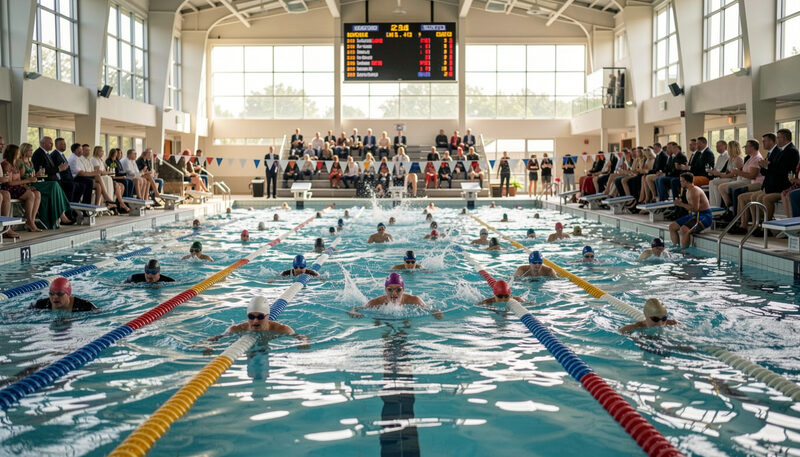
A swimming gala is a long, noisy, wonderfully organised day, and the first one can be confusing for a family that has never been to one. This guide explains what happens from the moment an entry is sent to the moment the results are published, so that a swimmer and their parents know what to expect and what to bring.
What a gala is
A gala, also called a meet, is a competition where swimmers race against others in the same age group and event. Events are defined by stroke and distance, such as the 50 metre freestyle or the 100 metre breaststroke, and swimmers are grouped by age, usually in single years for younger swimmers and in bands for older ones. A gala may last a single session or a full day, split into a morning and an afternoon session.
Some galas are friendly and unlicensed, run by a club for its own swimmers. Others are licensed by the governing body, run to strict technical rules, and produce official times. A licensed meet is the one that matters for qualifying for larger competitions.
Entries come first
Before the day, the club enters its swimmers. For licensed meets, entries are made with recorded times, which is why a swimmer needs a PB in an event to enter it. A coach decides which events each swimmer will swim, balancing the swimmer's development against the demands of the day. Parents usually receive a list of events and a timetable in advance, along with the cost of entry.
The day itself
A gala day begins with a warm up. Swimmers arrive well before their first race, get changed, and spend time in the pool loosening up. Then the racing starts. Events run in order, usually with heats followed by finals for the faster swimmers, and the whole day is kept moving by a team of officials and volunteers.
Between races, swimmers rest, eat light snacks and stay warm. Parents, meanwhile, find a seat in the gallery or volunteer on poolside. It is worth knowing that a gala is not a spectator sport in the usual sense: races last seconds, and most of the day is waiting. A book, a flask and comfortable shoes make the day far more pleasant.
Timekeeping and disqualifications
Every swim is timed electronically or by hand, and the times are recorded. Swimmers are also watched by technical judges, who check that each stroke is swum to the rules. A swimmer who breaks a rule, such as an illegal turn or an incorrect stroke, is disqualified, shown as DQ on the results. Disqualifications are common at every level, including among experienced swimmers, and they are a normal part of learning the sport rather than a disaster.
Other codes appear on results too. A no show, or NS, means a swimmer did not swim an event they had entered. A withdrawal, or WD, means they pulled out in advance. A did not finish, or DNF, is rare and usually means something went wrong during the race.
Reading the results
After the gala, results are published, usually online within a day or two. Each swimmer's time is listed alongside their placing, and the times feed into the national database. Understanding what the numbers mean, and why a swimmer's time in a 25 metre pool differs from the same swim in a 50 metre pool, is explained in reading swim times.
What parents do on the day
Most galas cannot run without parent volunteers. Clubs need timekeepers, judges, marshals and people to run the results desk. A family new to the sport will often be asked to help, and training is provided. Beyond volunteering, the parent's job is simple: get the swimmer there on time, keep them fed and warm, and stay calm. A nervous parent on the balcony is no help to a nervous swimmer on the blocks.
Why galas are worth it
Competition gives training a shape and a purpose. It also teaches swimmers to handle pressure, to lose gracefully and to measure progress over seasons rather than weeks. Not every swimmer enjoys it, and no one should be forced. But for those who do, a gala is where the work in the pool becomes visible. The wider club system is described in the clubs and competition section, and the squads that lead to a first gala are set out in the club pathway. The district that licenses many of these meets publishes its calendar at sasaeastdistrict.org.uk.
A first gala checklist
A first gala is easier with a short list. Bring two costumes and two towels, because a swimmer who races more than once will be wet between races. Bring a club shirt or a warm layer to wear between events, since poolside is cold. Bring water, light snacks and something to do during the long waits. Bring a spare pair of goggles, because the pair that has never leaked will choose the gala to start. And bring a pen, because parents are often asked to write times on a programme.
Before the day, check the warm up time, the events the swimmer is entered in, and where the family should sit or stand. On the day, arrive early, keep the swimmer calm, and remember that the result matters far less than the experience. A swimmer who enjoys their first gala will want a second.
After the gala
The work does not stop when the last race ends. Results are checked, splits are compared against the plan, and the coach uses them to set the next block of training. A swimmer who raced badly learns more from a gala than one who won easily, provided the family treats it that way. The drive home is not the place for a technical review.