Swimming Life
Swimming for Fitness
Build a weekly swimming habit: session structure, intervals, pacing, how many lengths to aim for, and why technique beats distance for fitness gains.
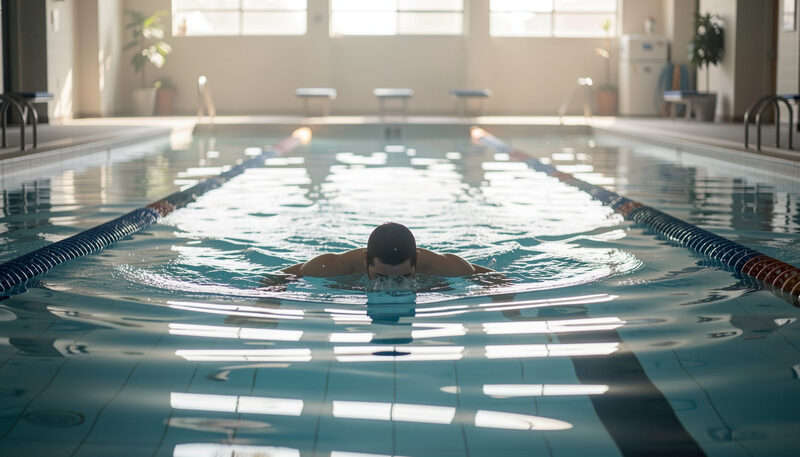
Swimming for fitness is simple in principle and surprisingly easy to get wrong. Most people swim a steady distance at the same pace, week after week, and then wonder why their fitness stops improving. The answer is that the body adapts to what it is asked to do, and a session that never changes asks very little. This guide sets out a straightforward weekly structure that works for almost any adult swimmer.
Start with technique, not distance
The first principle of swimming for fitness is that better technique means more fitness for the same effort. A swimmer who reduces drag and improves their catch covers more distance with less energy, which allows longer and harder sessions. Before chasing distance, spend a few weeks on stroke work: body position, breathing, and an efficient pull. A single lesson or a coach's eye can be worth more than months of grinding out lengths.
For beginners, the goal is to be able to swim a few hundred metres without stopping. For those who can already do that, the goal is to swim faster or further, and the way to get there is structure.
The shape of a session
Every good session has three parts. A warm up of a few hundred metres at an easy pace gets the body ready. The main set is where the work happens, and it should be harder than the warm up, often broken into shorter efforts with rest. A cool down of a few easy lengths brings the heart rate down. Skipping the warm up is the most common mistake, and it is also the one that leads to injury and bad technique.
The main set is where variety matters. Instead of swimming 1,000 metres straight, swim it as ten lengths of 100 metres with a short rest, or as a set of 50 metre efforts with easy lengths between. The rest is not laziness; it lets you swim the hard efforts properly, which is what drives improvement.
A simple weekly plan
For most adults, two or three swims a week is enough to build real fitness. A workable structure is one longer, steady swim, one shorter, faster session, and, if there is time, one technique session focused on drills. The faster session might be a set of 50 metre efforts with rest, or a pyramid of increasing and decreasing distances. The steady swim builds endurance; the fast session builds speed; the technique session makes both easier.
If you only have time for one swim a week, make it count: a warm up, a main set that includes some harder efforts, and a cool down. A single well structured session beats three aimless ones.
How many lengths should you swim?
There is no universal number. A beginner might aim for twenty lengths, an experienced swimmer for a mile or more. The useful target is the one you can repeat consistently without dreading it, and then a little more. Increase distance or intensity gradually, by no more than about ten percent a week, and take an easy week now and then.
It is also worth measuring progress in ways other than distance. A swimmer who swims the same set with shorter rests, or who holds a faster pace for the same effort, has improved even if the total distance is unchanged.
Staying with it
The main reason people stop swimming for fitness is boredom, not difficulty. The cure is variety and company. Change the set, change the stroke, swim with a friend or join a squad. Masters sessions, described in the guide to masters swimming, solve the boredom problem for many adults by providing a coached, structured hour with other people.
For open water swimmers, the same principles apply in colder, less controlled conditions, covered in sea swimming in the Forth. Whatever the setting, the essentials are the same: warm up, work hard in the middle, cool down, and come back next week. More structure and guidance for adult swimmers is gathered in the swimming life section, and the national governing body publishes fitness and technique resources at swimming.org.
Warming up and avoiding injury
Swimming injuries are usually overuse injuries of the shoulder, and they almost always begin with a warm up that was skipped or a stroke that was rushed. The shoulder is a mobile joint, and the repetitive pull of front crawl loads it heavily. A proper warm up, some easy backstroke, and gradual increases in intensity protect it. So does technique: a swimmer who pulls with a dropped elbow loads the shoulder far more than one with a good catch.
If a shoulder starts to ache, the answer is not to swim through it. Reduce the volume, focus on other strokes, and see a physiotherapist if it persists. Most swimming shoulder problems settle quickly if they are caught early.
Tracking progress
Fitness improves quietly. A useful habit is to note a few numbers after each session: the total distance, the time, and how hard it felt. Over weeks, the pattern becomes clear even when no single session feels different. A swimmer who can hold a faster pace at the same effort, or swim the same set with shorter rests, is fitter, whatever the scale says.
For a more structured route, a coached masters session does the planning for you, as described in the guide to masters swimming.
Swimming with a goal
Fitness is easier to keep when it points somewhere. A goal does not have to be a race: it might be a continuous mile, a charity swim, a faster 400 metres, or simply swimming a length of front crawl without stopping. Whatever it is, writing it down and giving it a date turns aimless lengths into a plan, and a plan is what carries a swimmer through the weeks when the pool feels like a chore.