Learn to Swim
The Four Swimming Strokes
Front crawl, backstroke, breaststroke and butterfly explained: body position, breathing, common faults and how each stroke is used in a pool or the sea.
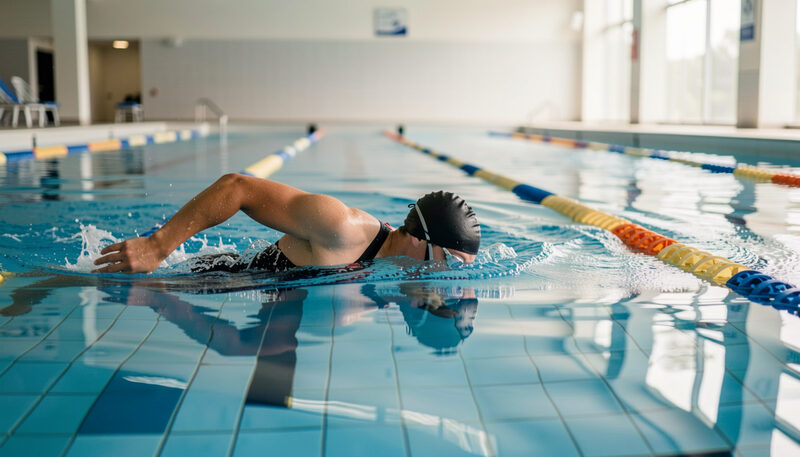
Swimming has four competitive strokes, and each one solves the same problem in a different way: how to move through the water while getting enough air. Understanding what each stroke is for, and what usually goes wrong, helps swimmers of any level, whether they are learning in a Fife pool or training for a gala. This guide describes the four strokes plainly, without pretending that a few paragraphs can replace a teacher.
Front crawl: the fastest and the most tiring at first
Front crawl, also called freestyle in races, is the fastest of the four strokes. The swimmer lies face down, arms alternating in a long pull, legs kicking in a steady flutter, and turns the head to the side to breathe. Its speed comes from a streamlined body position and a continuous arm action.
The common faults are easy to list and hard to fix. Swimmers lift their head to breathe, which sinks the legs. They bend their knees too much in the kick, which wastes energy. They cross the centre line with an arm, which makes the body snake. And they hold their breath instead of breathing out steadily under the water, which leaves them short of air after a length. Of all the strokes, front crawl rewards patient technique work the most.
Backstroke: crawl on the other side
Backstroke is front crawl turned over. The swimmer lies on their back, arms alternating overhead, legs fluttering, and breathes freely because the face is always out of the water. That free breathing makes backstroke a favourite for beginners and for anyone swimming for fitness, since it allows long, unhurried lengths.
The main difficulty is direction. A swimmer on their back cannot see where they are going, and in a busy lane that means collisions. Pools solve this with flags or a marked ceiling. Technically, the faults are a sagging hips position, an arm that enters too wide, and a head that tips back so far that water runs over the face. A good backstroke is built on a strong, still core.
Breaststroke: the slowest and the most technical
Breaststroke is the oldest of the racing strokes and the one with the most rules. The swimmer lies face down, pulls both arms together, kicks both legs in a whip, and lifts the head to breathe on each stroke. It is the slowest stroke in a race but often the most comfortable for a recreational swimmer, because the head stays near the surface and the rhythm is steady.
The faults tend to be timing faults. Swimmers pull and kick at the same moment, which brakes them. They lift the head too high. They let the knees come too far apart. Breaststroke has a strict rulebook in competition, and swimmers are disqualified for small deviations, which is why coaches spend so long on it. For a learner, the goal is simply a smooth glide between strokes.
Butterfly: powerful and demanding
Butterfly is the most demanding stroke. Both arms sweep over the water together while the body moves in a wave, and the legs kick in a dolphin motion. It requires strength, timing and a strong core, and it is usually the last stroke a swimmer learns. In a race it is fast, but it tires a swimmer quickly, and even strong swimmers rarely hold it for long distances.
Beginners should not rush towards butterfly. It is built on the same fundamentals as the other strokes, and a swimmer who can float, glide and breathe well will learn it far more easily than one who cannot.
Which stroke should a beginner learn first?
Front crawl and backstroke are usually taught first, because they share the same flutter kick and the same body position. Breaststroke comes next for many, and butterfly last. There is no single right order, and a good teacher will adapt to the swimmer. The important thing is that the strokes are built on floating, gliding and breathing, which are covered in the guide to teaching a child to swim and in the learn to swim section.
Strokes in a pool and strokes in the sea
In open water, the strokes behave differently. Front crawl is fast but hides the view, so many sea swimmers lift their head to sight a landmark every few strokes. Breaststroke allows a swimmer to see where they are going, which is one reason it is popular on the coast. Backstroke is rarely used in open water because the swimmer cannot see hazards. The practical side of swimming in the Forth is covered in sea swimming in the Forth.
How strokes are judged and timed
In competition, each stroke has technical rules, and a swimmer who breaks them is disqualified. Times are recorded to hundredths of a second and compared against personal bests and qualifying times, a subject explained in reading swim times. For most swimmers, though, the value of learning the strokes properly is simpler: it makes swimming easier, faster and more enjoyable, whatever the clock says. The national governing body publishes stroke guidance and videos at swimming.org.
A word on learning order
Whichever stroke a swimmer starts with, the sequence that works is the same: float, glide, breathe, then stroke. A swimmer who rushes to the strokes before the foundations are in place will spend years correcting habits that a few patient weeks would have avoided. The order of learning is set out in the guide to teaching a child to swim.